



Manufacturing Technology

Saporin possesses extremely potent ribosome‑inactivating activity (Ribosome‑Inactivating Protein; RIP), and its strong cytotoxicity causes severe growth inhibition in common expression hosts such as E. coli. As a result, the stable recombinant expression and high‑yield production of saporin have long been recognized as major technical challenges across the industry.
PhotoQ3’s Breakthrough in Overcoming the Saporin Production Bottleneck
PhotoQ3 has established a proprietary manufacturing process that enables the stable supply of recombinant saporin for research use.
1. Stable Expression Technology for Saporin
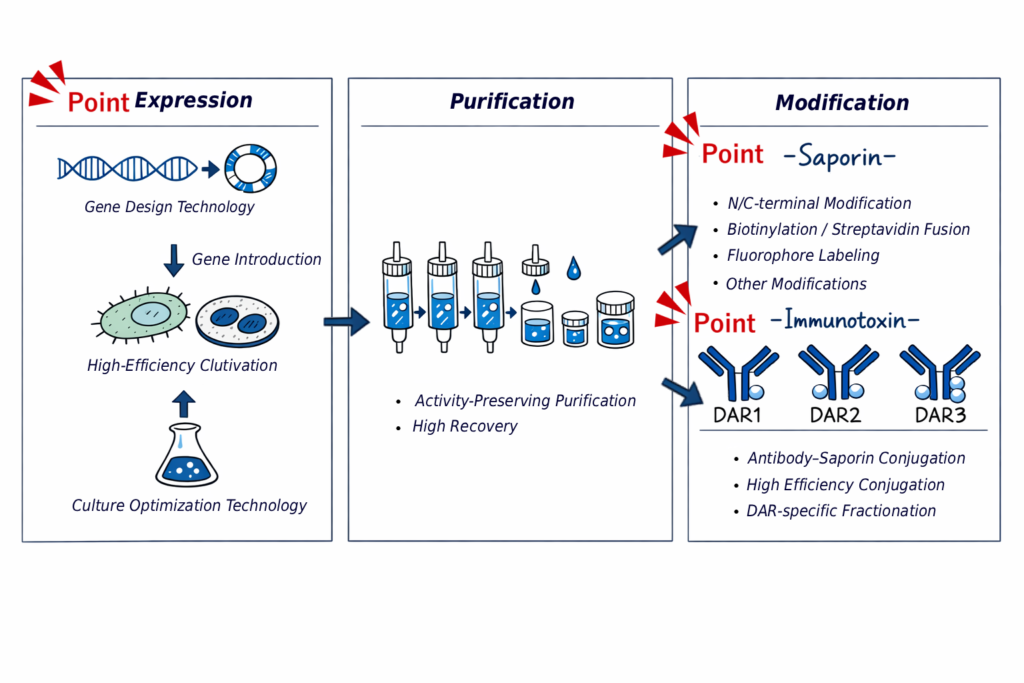
PhotoQ3 has developed a proprietary vector‑design strategy that precisely modulates saporin’s intrinsic toxicity, creating an expression environment that host cells can tolerate. In addition, through systematic optimization of culture conditions, we have achieved expression efficiencies 10–100 times higher than conventional approaches.
By dramatically improving the productivity of saporin—long regarded as a “difficult‑to‑express” protein—PhotoQ3 has established a robust supply foundation not only for research‑use material but also for advanced application‑oriented technology development.
2. Advanced N‑terminal and C‑terminal Molecular Engineering
PhotoQ3 possesses a proprietary design technology that enables flexible chemical modification and protein fusion at both the N‑terminus and C‑terminus of the saporin molecule. This allows saporin to be offered as a highly extensible platform applicable across a wide range of uses—from basic research to therapeutic development.
Streptavidin Fusion
- Enables conjugation with virtually any antibody or protein
- High‑affinity binding to biotinylated molecules allows diverse assay designs and drug‑delivery strategies
Fluorophore Conjugation
- Facilitates visualization of intracellular trafficking, uptake efficiency, and membrane‑translocation behavior
- Useful for imaging studies and mechanism‑of‑action analysis
Addition of Various Tags
- Improves purification efficiency and usability for research workflows
- Supports incorporation of different tags depending on experimental requirements
Flexible N/C‑terminal Design Expansion
- Allows functional tuning, activity modulation, and assay adaptation tailored to user needs
- Highly suitable as a base unit for drug‑conjugate development and diagnostic applications
3. Immunotoxin Engineering Technology
PhotoQ3 has established an engineering platform capable of producing immunotoxins that integrate antibodies and saporin with high efficiency and precision. Our system enables high conjugation efficiency, uniform drug‑to‑antibody ratios (DAR), and flexible linker selection—meeting the quality requirements essential from early research through practical development. This allows the design of immunotoxins with excellent target specificity, pharmacological performance, and manufacturing stability, thereby supporting drug discovery and development.
High‑Efficiency Conjugation of Saporin and Antibodies
- Combines saporin‑modification technologies with antibody‑production methods to achieve rapid, high‑yield conjugation
- Enables conjugation without compromising the antibody’s three‑dimensional structure or biological activity
Uniform DAR (Drug‑to‑Antibody Ratio) Immunotoxin Production
- Reaction‑control technologies significantly reduce DAR variability
- Provides a major advantage in development stages where formulation reproducibility and uniformity are critical
DAR‑Specific Fractionation and Purification
- Advanced analytics combined with separation technologies enable selective isolation of specific DAR species
- Allows the provision of “optimized DAR products” tailored to intended applications
Collaboration Opportunities
PhotoQ3 is seeking research partners to collaborate using our proprietary platforms for high‑yield recombinant saporin production and uniform‑DAR immunotoxin engineering.
We offer broad flexibility, including the creation of new modalities in combination with your assets, functional enhancement studies, and joint PoC activities.
Please feel free to contact us to explore potential collaborations.